

Treatment of Salivary Gland Disorders

MRCS (Edinburgh, UK), FAMS (Otolaryngology)

FRCS (Glasgow), FAMS (Otolaryngology)

What Are Salivary Gland Disorders?
The salivary glands play an important role in producing saliva, which helps digest food, keeps the mouth moist, and protects against bacteria and tooth decay. When these glands become blocked, infected, or develop growths, problems such as pain, swelling, or dry mouth can occur.
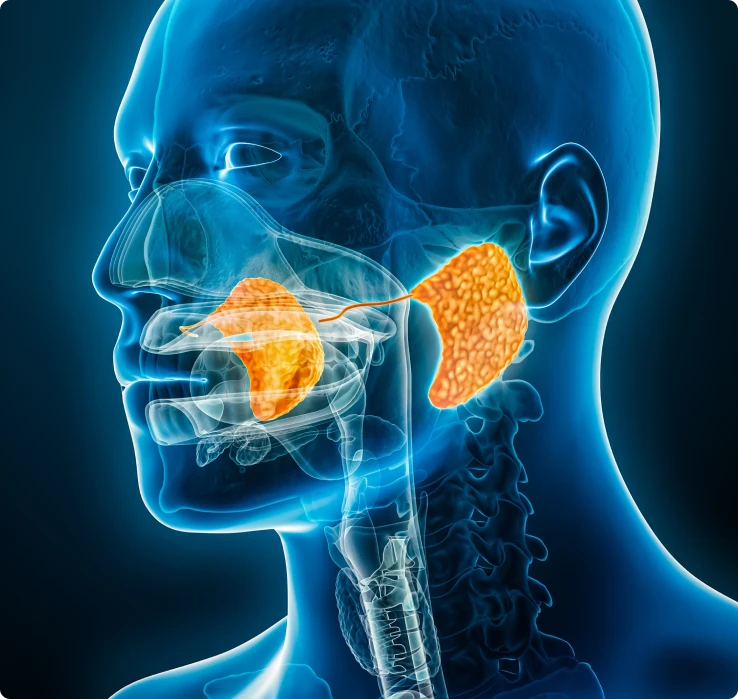
There are three major pairs of salivary glands (parotid, submandibular, and sublingual) along with many smaller minor glands located throughout the mouth. Disorders affecting these glands may range from simple infections to more complex tumours.
At our clinic, we provide comprehensive diagnosis and treatment for all salivary gland conditions, combining advanced imaging and minimally invasive techniques to achieve effective relief and preserve gland function.
What Are Common Types and Causes?
Salivary gland disorders can arise from a variety of causes, including blockages, infections, autoimmune conditions, or tumours. The most common types include:
- Cysts and Tumours: Benign or malignant growths that may develop in any of the major or minor glands, particularly the parotid and submandibular glands.
- Autoimmune Conditions (e.g., Sjögren’s Syndrome): These disorders cause reduced saliva production, leading to chronic dry mouth and discomfort.
- Sialolithiasis (Salivary Stones): Mineral deposits that form within the salivary ducts, obstructing the normal flow of saliva.
- Sialadenitis: Inflammation or infection of the salivary glands, often caused by bacterial overgrowth due to a blockage.
In many cases, dehydration, poor oral hygiene, or reduced saliva flow may increase the risk of developing stones or infections.
Common Symptoms to Look Out For
Symptoms can vary depending on the cause and location of the problem. You may notice:
- Swelling or pain near the jaw, cheek, or under the tongue
- Dry mouth or difficulty swallowing
- Bad taste or pus discharge into the mouth
- Recurrent swelling or pain during meals
- A firm lump in the cheek or under the jaw
How Are Salivary Gland Disorders Diagnosed?
A thorough examination is performed in order to identify the cause and guide treatment. Your ENT specialist may recommend:
- Ultrasound or CT Scan: To detect stones, cysts, or masses in the salivary glands and ducts.
- Sialography: A specialised imaging test that outlines the salivary ducts to identify narrowing or blockages.
- Fine Needle Aspiration (FNA): A simple and safe biopsy technique used to test suspicious lumps or tumours for accurate diagnosis.
- Endoscopic Examination (Sialendoscopy): A minimally invasive method to directly visualise the salivary ducts and locate stones or strictures.
What Are the Main Treatment Options?
Treatment for salivary gland disorders depends on the underlying cause and the severity of symptoms. These may include:
When to See a Specialist?
You should seek evaluation by an ENT specialist for a suspected salivary gland disorder if:
- You experience recurrent swelling or pain during meals
- You notice a lump or swelling in the cheek, jaw, or under the tongue
- You have persistent dry mouth or thick saliva
- There is discharge, pus, or foul taste in the mouth
- Symptoms persist despite medical treatment
Early consultation allows timely diagnosis and treatment to take place, which helps to prevent complications from developing.

FAQs
OUR DOCTORS
Meet Our
ENT Specialists
Our clinic is led by two experienced ENT specialists, each with their own subspecialties, offering comprehensive expertise across all areas of ENT care. This ensures our patients receive care that is both broad in scope and deep in specialised insight.

Dr Barrie Tan
Senior Consultant ENT Specialist
MBBS (Singapore), MMed (ENT) (Singapore)
MRCS (Edinburgh, UK), FAMS (Otolaryngology)
Dr Barrie Tan has over 25 years of experience in ENT, particularly in the field of hearing loss and cochlear implants, snoring and sleep apnea, as well as endoscopic ear surgery.
Dr Barrie was a President’s Scholar and the former Head of the ENT Department at Singapore General Hospital (SGH) and the Director of the Centre for Hearing and Ear Implants. He continues to hold various leadership positions in several ENT professional bodies today.
At his practice, Dr Barrie places great emphasis on listening carefully to his patients and providing the most personalised and supportive care possible.

Dr Ranjit Magherra
Senior Consultant ENT Head & Neck Surgeon
MBBS (Singapore), FRCS (Edinburgh)
FRCS (Glasgow), FAMS (Otolaryngology)
Dr Ranjit Magherra is an accomplished ENT Head & Neck Specialist with over 25 years of experience. He was also fellowship-trained in Head & Neck and Thyroid Surgery.
Dr Ranjit was formerly the Head of the ENT Head & Neck Surgery Department at Ng Teng Fong General Hospital (NTFGH), as well as an Adjunct Assistant Professor at the National University of Singapore.
He has also received several Service Quality Awards during his time in the public sector and continues to bring the same level of dedication to his patients even today.